

Why choose dynamic leg supports over angle-adjustable leg supports?
A substantial number of studies have been conducted on leg supports. However, most of this research focuses on standard angle-adjustable leg supports. While these can be repositioned, we do not consider them truly ‘dynamic’ as they do not actively respond to the user’s movements.
In this section, we explain why true dynamic leg supports are preferable to angle-adjustable leg supports and in which situations they provide the greatest benefit.
Find item numbers for our Netti Dynamic leg supports and available accessories.
Dynamic leg supports and accessories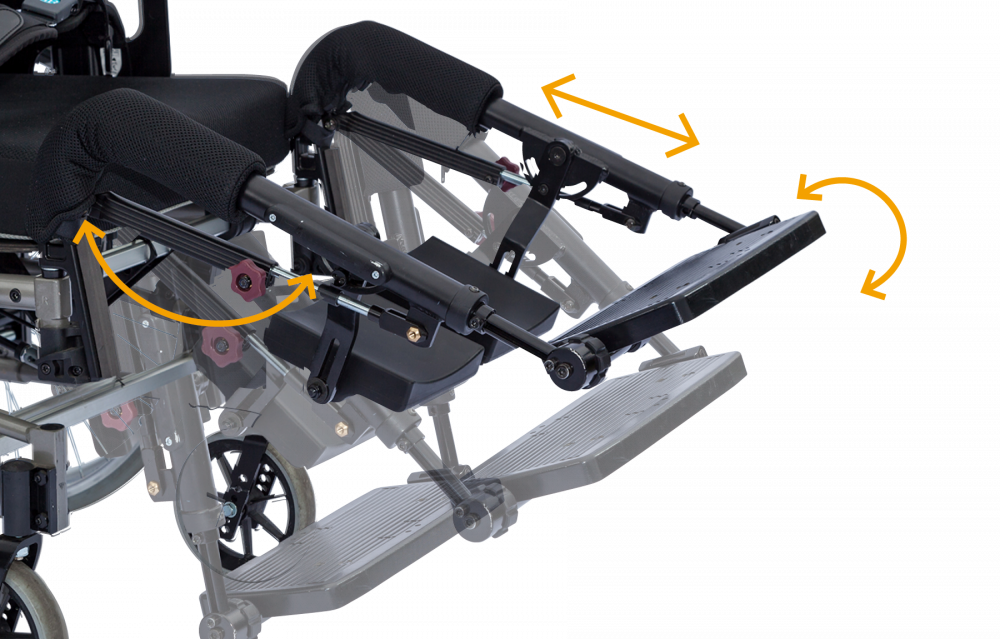
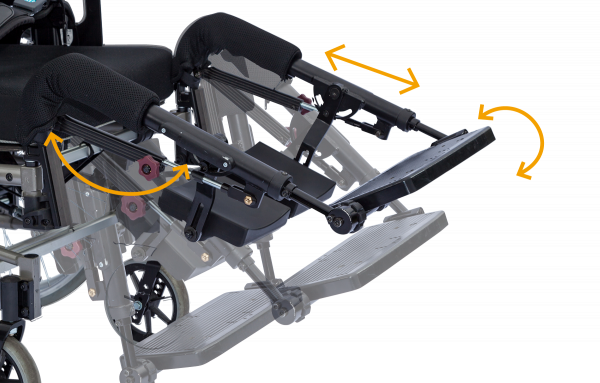
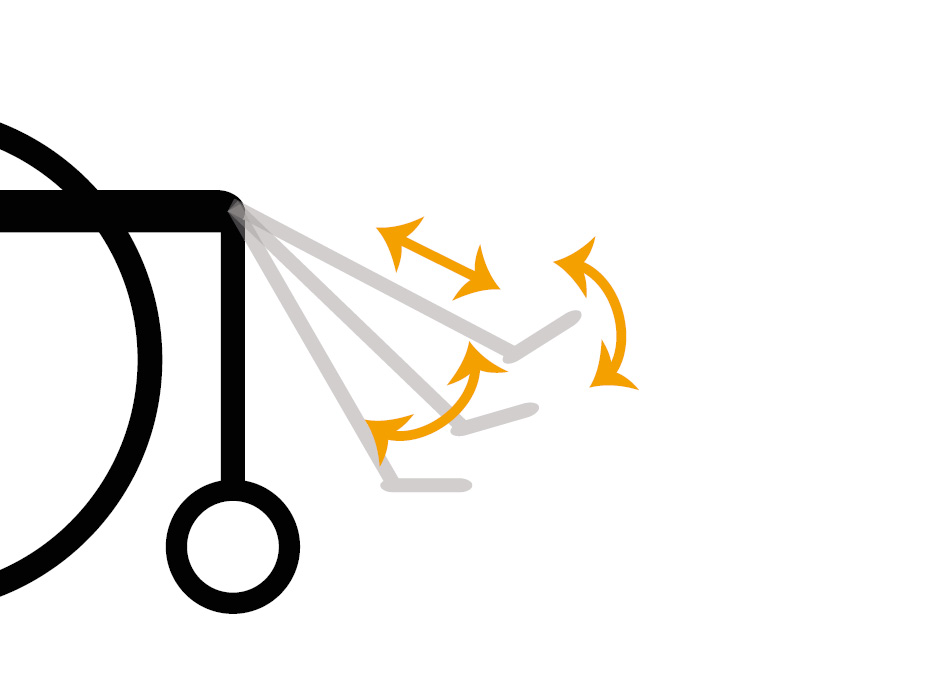
Why is it important to have these 4 movement options in a dynamic leg support?
At Netti, we believe it is essential to adapt the wheelchair to the individual user. When a mechanical challenge arises, it should be addressed at its point of origin. For example a challenge at the knee joint should be managedat the knee.
Involuntary movements often affect multiple parts of the body simutaneously, influencing overall posture and stability. The lower extremities are often involved and may generate significant movement, which is why leg supports need to be able to respond dynamically.
Each movement should be accomodated where it occurs, in the appropriate direction and with the necessary range of motion. This ensures more effective support, improved comfort, and better overall positioning.
The knee flexion / extension
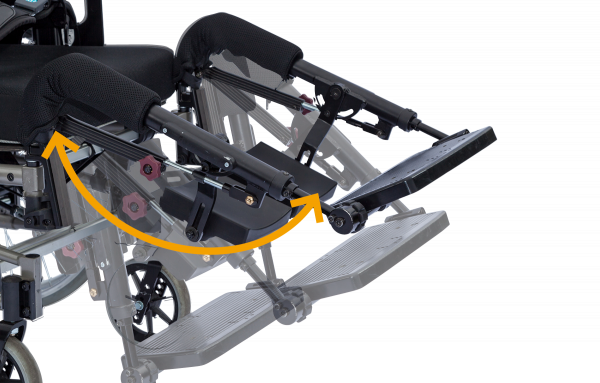
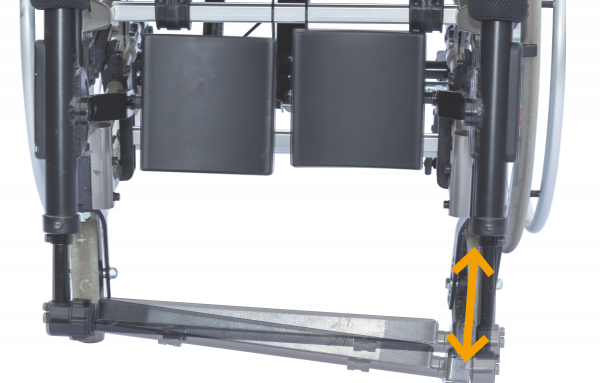
The position of the leg support is closely linked to knee extension. When the angle of the lower leg support is adjusted, it can also affect the position of the hips – especially if the distance between the seat and the foot support changes.
This occurs because the pivot of the leg support is not aligned with the natural axis of the knee joint. As a result, changes in angle must be accompanied by changes in length to maintain proper alignment. If this is not managed correctly, it can lead to discomfort, loss of position, and even soft tissue injury [1, 2].
For example, if a leg support is elevated without adjusting the length of the foot support, the hip and knee joints are forced into flexion. This increases pressure under the ischial tuberosities and may compromise seating stability.
To avoid this, it is essential to use solutions that allow the foot support to extend as the leg support elevates. Netti dynamic leg supports are designed with proper alignment between the leg support axis and the knee joint, ensuring a more natural and supported movement.
Some manufacturers attempt to solve these mechanical challenges at the knee by compensating elsewhere in the system. This has led to the development of so-called compensatory (CMP) leg supports.
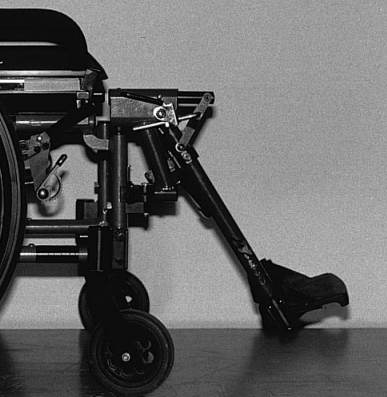
Example of CMP leg support as used in (2)
At Netti, we take a different approach. We believe that the principles behind compensatory (CMP) leg support should be applied to manage full-body extension patterns, such as those seen during spasms or involuntary movement.
However, using CMP leg supports aline is not sufficient to address the underlying mechanical mismatch between the knee joint and the leg support. Nor does it adequately accommodate the full-body extension tat occurs during involuntary movements.
A more effective solution must address both the local joint mechanics and the overall movement patterns of the body.
The plantar / dorsal flexion which occurs in the ankle joint and foot
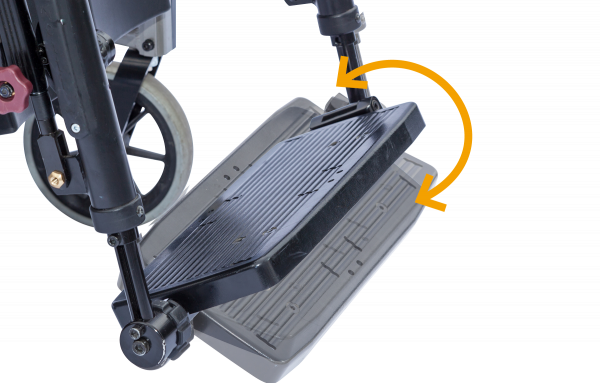
When involuntary movements occur in the lower extremities, they are often accompanied by plantar and dorsiflexion in the ankle and foot. In many cases, extension patterns lead to strong plantar flexion.
A standard footplate cannot accomodate this type of movement. As a result, a closed kinetic chain is created, causing tension to build up in the body. This can lead to discomfort, increased muscle spasms, and in some cases result in user injury or damage to the wheelchair.
Netti dynamic leg supports are designed to accomodate these movements, allowing the foot and ankle to more more naturally. This creates an open kinetic chain, reducing muscle tension and leading to improved comfort, fewer spasms, and a lower risk of injury or equipment damage.
The longitudinal movement in the direction of the lower legs, to adjust for total body extension
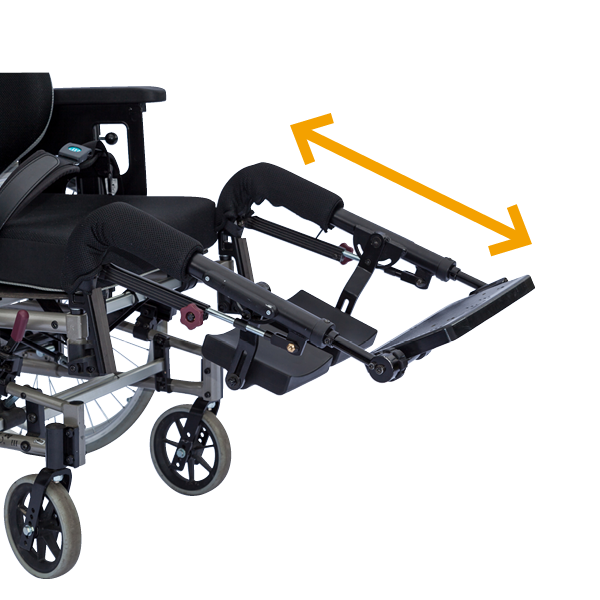
When involuntary movements occur, they often affect multiple areas of the body simultaneously and are typically part of a movement pattern – most commonly an extension pattern.
An extension pattern increases the overall length of the body. Netti dynamic leg supports are designed to accomodate this movement.
Standard leg supports do not allow for such extension. As a result, a closed kinetic chain is created, causing tension to build up in the body. This can lead to discomfort, increased muscle spasms, and a higher risk of user injury or damage to the wheelchair.
Netti dynamic leg supports allow for natural movement, creating an open kinetic chain. This reduces muscle tension and results in improved comfort, fewer spasms, and a lower risk of injury or equipment damage.
Independent movement between each of the leg supports
We all know that while the human body is build symmetrically, it often does not function symmetrically. Involuntary movements are frequently asymmetrical, making it essential for leg supports to accomodate these variations.
References:
- E. Ward, Prescriptive Seating for Wheeled Mobility: Vol. I. Theory, Application and Terminology. Kansas City, MO: HealthWealth International, 1994
- Biomechanical Analysis of Legrest Support of Occupied Wheelchairs: Comparison Between a Conventional and a Compensatory Legrest Rachid Aissaoui, Member, IEEE, Sadeghi Heydar, Jean Dansereau, and Michèle Lacoste

We are happy to help!
Feel free to contact us for more information on Netti Dynamic leg supports.
Contact us for more information